
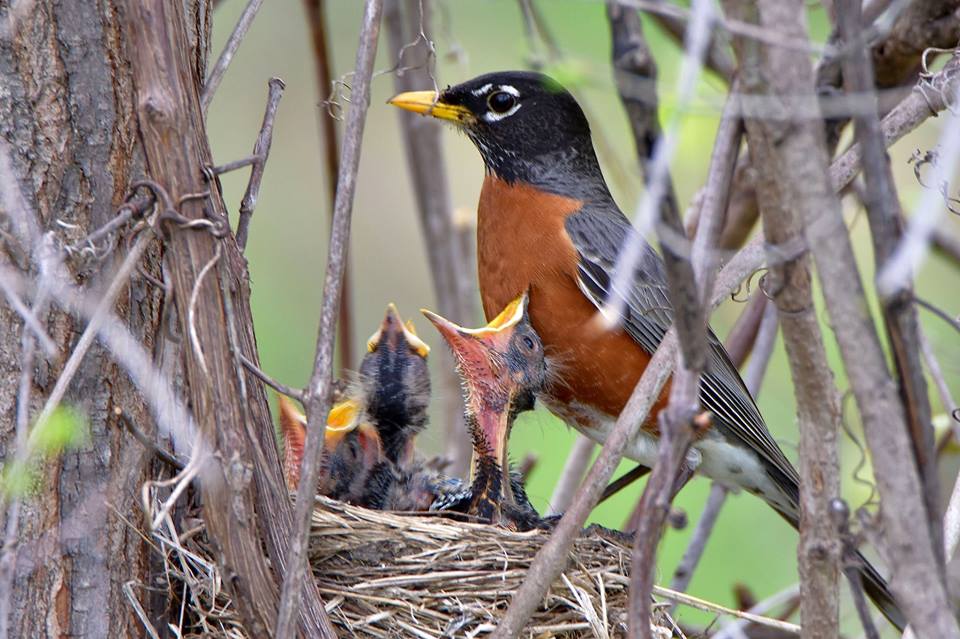
Birding has recently become one of my favorite family pass times. This is partially because birding with kids can happen almost anywhere. It is amazing how many birds we can spot or hear in our own backyard. Even driving down the highway near the Mississippi, we have a good chance of spotting a bald eagle.
Twin Cities Family Birdwatching Opportunities:
- 04/30/2026 Thursday Evening at Eloise Butler Wildflower Garden (FREE)
- 05/02/2026 Bird Migration Hike (FREE)
- 05/02/2026 Carpenter Minnesota Guided Bird Hike
- 05/02/2026 Twin Cities Bird Festival (FREE)
- 05/02/2026 Raptor Encounters Tour
- 05/09/2026 Wings of Spring Migration Celebration (FREE)
- 05/09/2026 Carpenter Wisconsin Guided Bird Hike
- 05/16/2026 Lowry Bird Banding (FREE)
- 05/16/2026 Bell Museum Open Birding (FREE)
- 05/17/2026 Raptors Up Close (FREE)
- 09/26/2026 Carpenter Fall Raptor Release (FREE)
- 05/17/2026 Raptors Up Close (FREE)
- 05/16/2026 Bell Museum Open Birding (FREE)
- 05/16/2026 Lowry Bird Banding (FREE)
- 05/09/2026 Carpenter Wisconsin Guided Bird Hike
- 05/09/2026 Wings of Spring Migration Celebration (FREE)
- 05/02/2026 Raptor Encounters Tour
- 05/02/2026 Twin Cities Bird Festival (FREE)
- 05/02/2026 Carpenter Minnesota Guided Bird Hike
- 05/02/2026 Bird Migration Hike (FREE)
Birding Equipment To Keep In the Car:
While some parks, such as Eloise Butler Wildflower Garden and North Mississippi Regional Park allow visitors to check out backpacks with birding equipment, not all parks do. Even parks that have packs to loan don’t provide some personal necessities. We find it worthwhile to keep an exploration pack in the back of our van. Here’s a birding checklist of what we keep:
1. Binoculars:
This is probably the most expensive, but also most necessary item on the checklist. I do see binoculars regularly at thrift stores, but its not always easy to determine their quality. We really enjoyed birding at North Mississippi Regional Park, where they were happy to loan us enough binoculars for the family. If you are bringing your own, sharing works pretty well. We like the Imagine Childhood’s
2. Bird Guide Book:
Bird guides are pretty easy to find anywhere that sells books, but I particularly like The Kids’ Guide to Birds of Minnesota for a family backpack because it includes interesting facts including where each bird nests and what their calls sound like. It also has a section with additional activities families can do together. If you are bringing a phone, you could also just open up the Minnesota DNR’s Interactive Bird Songs Poster.
3. Hats for everyone:
I have a family full of Scandinavian children with pale skin and sensitive eyes. I always regret when we don’t have hats with us. Luckily I can usually thrift plenty of hats cheaply, so they are no big loss when they get left behind, which they often do. It’s good to keep a few extra tucked in the van.
4. Sunglasses:
As cute as sunglasses are on my kids, and as sensitive as their eyes are, they don’t keep them on. So we also pick these up cheap at thrift stores and more often than not, rely on hats.
5. Bug Spray:
I wish I had a good recommendation on this. However, I’m on the search for a safe but effective bug spray to use with my own kids and dog this year. Some State Forest Campgrounds where we have camped have been pretty miserable with mosquitoes and this is supposed to be a bad tick year. Still, I’m uncomfortable using pesticides on kids and dogs – both of whom may just lick themselves at any time. If you have a recommendation or a recipe, leave it in the comments.
6. Sunscreen:
I really, really don’t like to use sunscreen, but again, Scandinavian children burn easily. I try to find one with the least harmful chemicals, use sparingly and do my best to keep my kids out of the sun during peak hours. We also double up on green smoothies during summer months.
Birding Checklist of Items We Grab Before Going:
7. Clean and Refilled Water Bottles:
I like something with a strap that I can carry easily and will keep drinks cold (or hot).
8. Snacks:
I envy parents who remember to keep snacks packed. I always end up stopping to buy a box of granola bars.
9. Your Cell Phone:
This isn’t absolutely necessary, but it’s nice to compare bird songs with an online resource. As we mentioned above, the Minnesota DNR offers a great resource here. I keep a Bird ID app on my phone to identify the birds vocalizing in the area and give me an idea what I’m looking for. Plus, you might be able to get some good photos with your phone.
How to Dress for Birding:
Dress comfortably for the weather, wear layers and comfortable hiking shoes or walking shoes. If you are worried about ticks, you can wear longer clothes and tuck your pants into your socks.
At Home Birding Checklist:
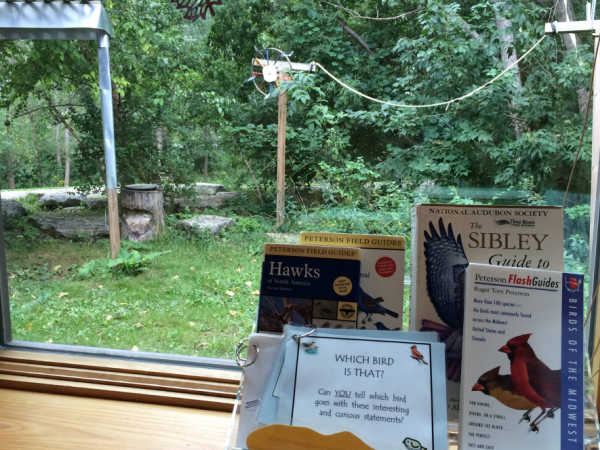
Although sometimes a set of binoculars are nice at home, usually, in the summer, we can just lie quietly on the deck and lazily watch the trees above. Its fun to do this in the morning with a cup of coffee or in the evening when the squirrels are going to bed. In the winter, we can set up a bird feeder right outside of our living room window. There are different types of bird food that attract different kinds of birds. You can learn more about that from the Minnesota DNR. You can also visit a local nature center.
 DIY Birdfeeders to Encourage Backyard Birds
 DIY Birdfeeders to Encourage Backyard Birds
I always love visiting Non-Toy Gifts for fun craft ideas. This list of 15 DIY Bird Feeders Made From Recyclables doesn’t disappoint. My favorite is made with an old dust pan. This can be a fun start to a backyard (or front yard) bird-watching area. We’re working on setting one up in front of our bay window.
10 Year-Round City Birds
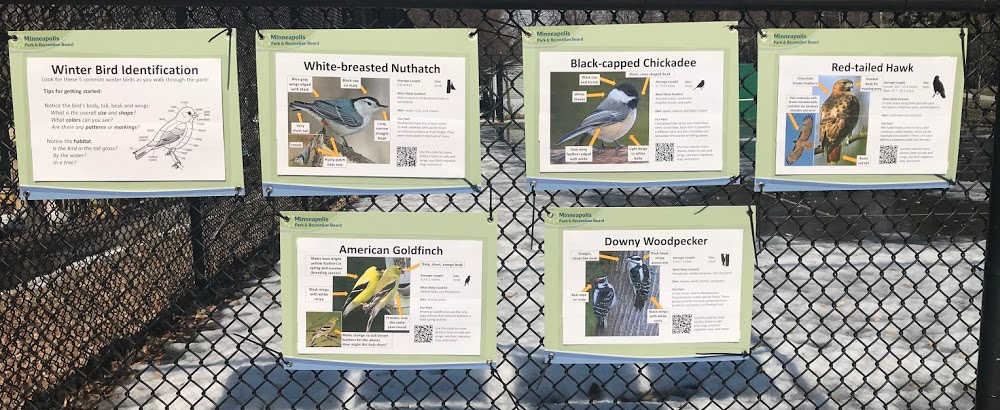
You don’t have to leave Minneapolis or St. Paul to watch birds. We found Winter Bird Identification signs at a Minneapolis park with five birds that you might see in the winter in the city. I actually looked up after taking this photo and saw a red-tailed hawk flying above us. This grouping didn’t include my favorite, the cardinal, which are prevalent and easy to spot. Plus we’ve added a few more easy to find urban birds. We’ve added links to more information from the Minnesota Bird Atlas and to videos of each bird’s call.
- White-Breasted Nuthatch (Information)(Call)
- Black-Capped Chickadee (Information)(Call)
- Red-Tailed Hawk (Information)(Call)
- American Goldfinch. If you want to attract goldfinch to your own garden, plant sunflowers. (Information)(Call)
- Downy Woodpecker. I often see these little guys hopping around my trees. (Information)(Call)
- Northern Cardinal. Remember the males are the red birds. The females are brown, but look similarly shaped (Information)(Call)
- Rock Pigeon – Find these guys downtown where they are the favorite prey of the peregrine falcons that also call Downtown Minneapolis home. (Information)(Call)
- American Robin. Did you know that not all robins fly south in the winter? Although we are used to seeing Robins in spring on the ground, look up in the trees when the ground is too frozen to catch a worm. (Information)(Call)
- American Crow – Just walk outside. You’ll probably hear them calling to each other. (Information)(Call)
- Canada Goose – Some choose to stay all winter, but they are easiest to spot in the spring through fall. (Information)(Call)
Bird Journaling with Local Illustrators
We have an amazing community of children’s book authors and illustrators in our community. Here are a couple resources for creating the birds you see in a journal or other format:
- Debra Frasier shows us how to make a bird with paper cutting from her November 22, 2022 Scissors Paper Glue newsletter.
- Learn to draw Cardinals with Nancy Carlson in her Nature Drawing with Nancy video series.
Useful Links and Printable Resources:
State Parks: The Minnesota DNR offers separate printable bird checklists for each of its parks.
This article includes an affiliate link to Bookshop.org, an online bookstore with a mission to financially support local, independent bookstores. Family Fun Twin Cities receives a small commission on books ordered through our link. If you want to find a specific local bookstore to support, find them on this map and they’ll receive the full profit off your order. Otherwise, your order will contribute to an earnings pool that will be evenly distributed among independent bookstores (even those that don’t use Bookshop). Learn more here.